Research by tHE gRID Architects Research and Design Studio
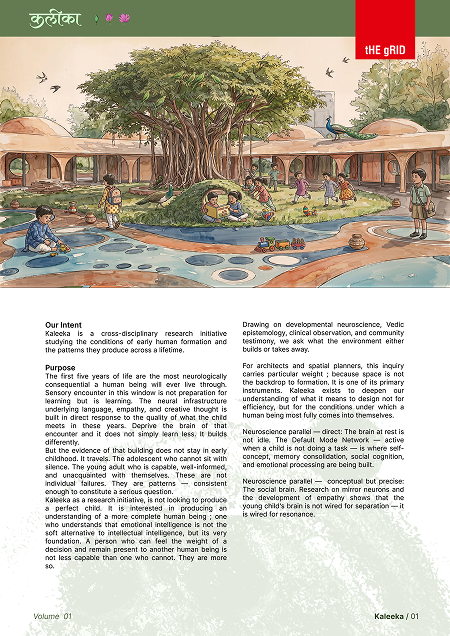
Kaleeka is a cross-disciplinary research initiative studying the conditions of early human formation and the patterns they produce across a lifetime.
Subscribe to our newsletter!
We understand more about the developing brain than at any previous point in human history. And yet the patterns we are seeing in the generations now reaching adulthood- anxiety, disconnection, an inability to sit with oneself- suggest that knowledge alone is not closing the gap. However, in the translation from what we understand to what we build, design, and decide for children, this is not holding. What remains largely unexamined is the loop. How early formation shapes the adult. And how that adult, carrying the trace of what their own environment built or withheld, goes on to create the conditions for the next generation. The relationship between what we received and what we produce- spatially, institutionally, relationally is both the most consequential and the least studied dimension of this question. Understanding this intergenerational cycle may be one of the most important questions before us. There is an equally significant methodological gap. Vedic epistemology and contemporary neuroscience have arrived, from entirely different directions, at convergent understandings of how a human being form. Yet they have not been tested against each other through simultaneous community testimony, clinical observation, and spatial analysis within a single open framework. That triangulation, across ancient philosophical tradition and modern developmental science, is both the methodological proposition of this research and the reason it requires the range of perspectives this inquiry is designed to gather. This study does not belong to any single discipline or institution. It is structured to be entered, extended, and used by anyone for whom the question carries weight: a therapist, a policymaker, a parent, a spatial planner, an educator. The survey instruments, panel conversations, and emerging findings will remain in the public domain because the question of what forms a human being is too consequential to remain inside any single field.
Over the past two decades, developmental neuroscience has consistently demonstrated that the earliest years of life are not only a preparation for who a person becomes but the fact that they are the becoming itself. During the same period, we have invested considerable effort in improving education through better schools, evolving policies, and more intentional learning environments. Yet The generation now reaching adulthood is the most anxious in recorded history. What forms a human being in the earliest years does not remain in childhood. It accompanies the adolescent learning to navigate uncertainty. This human is capable and unacquainted with themselves, and into the collective future we are building without fully examining its foundations. The question is not only about children. It is about what we are all already living inside of, and the conditions we continue to inherit and recreate. Kaleeka, a Sanskrit name for ‘the bud which is on the cusp of bloom’, is a cross-disciplinary research initiative that believes the answers do not live in any single discipline. They live in the accumulated observations of people who have spent years looking closely; as an architect who understands what a threshold does to a body, a therapist who traces anxiety back to its earliest conditions, an academician who encounters a person long after formation has occurred, a parent who makes spatial and emotional decisions daily, or simply as someone whose own life has brought them to certain conclusions about what was missing and what could have made a difference. Kaleeka extends this inquiry beyond architecture itself to better understand the earliest conditions that influence human development. At tHE gRID Architects | Research & Design Studio, our research has long explored the relationship between space, human behaviour, well-being, and the environments we inhabit and inherit and what we will give as a legacy.
This study intends to understand what whole intelligence can be; not IQ alone, which measures the capacity to process and perform, but the integration of emotional, embodied, and cognitive intelligence that allows a person to think clearly and know why they are thinking it. To feel the weight of a decision. To remain present to another human being with awareness. The Vedic tradition called this Prajna, not knowledge as accumulation, but knowledge as a quality of being. This research sits at the intersection of developmental neuroscience, Vedic epistemology, spatial design, and lived experience. It asks what conditions make that wholeness possible — and whether those conditions can be understood clearly enough to be nurtured, designed for, built and protected. We trace the question backwards from the adult to the child, and from the child to the environment that first shaped them. The loop, once understood, becomes something where meaningful interventions become possible. That is the aim.
This is the first phase of a two-stage inquiry in this exploratory qualitative research; a methodology designed precisely for questions where the variables are not yet fully known. The panel conversation and the survey are deliberately open, intended to surface the landscape of the question before parameters are set. Thematic analysis of the responses will determine the contradictions, patterns, and gaps that the research then moves toward with greater precision.